
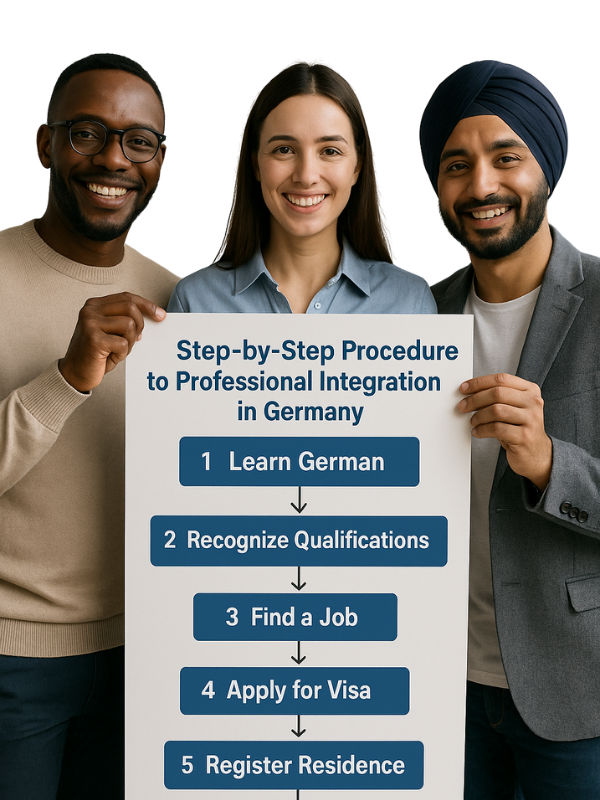
Step-by-Step Procedure to Professional Integration in Germany




Section 1: Executive Summary
This project presents a strategic and structured pathway to empower young individuals from developing countries with the opportunity to access professional training contracts in Germany. It specifically targets motivated youth seeking long-term employability and personal growth through vocational training, starting with an intensive 12-month German language and integration program based in Mauritius. Upon completion, candidates transition to a fully supported placement in a German company under a remunerated vocational training contract (Ausbildungsvertrag).
Key components of the program include:
A rigorous selection process to identify motivated and capable candidates.
An intensive, immersive language and intercultural training curriculum delivered in Mauritius.
Comprehensive administrative support, including visa processing, medical exams, insurance, and housing arrangements.
Strategic partnerships with certified German host companies and vocational institutions.
On-the-ground mentorship, support, and evaluation in both Mauritius and Germany.
Candidates contribute a participation fee of EUR 5,000, which covers training, accommodation, documentation, and placement services. Scholarships and subsidies are available for qualified low-income applicants, supported by a mix of donor and institutional contributions.
The program ensures that all operations meet international ethical, educational, and legal standards. It incorporates risk mitigation mechanisms, financial oversight, transparent governance, and robust support systems from start to finish. Once candidates complete their vocational training in Germany, they are well-positioned for full-time employment, continued education, or entrepreneurial ventures.
In essence, the project addresses the dual need for global workforce development and youth employment, enabling a new generation of skilled workers to build meaningful, secure futures across borders.
Section 2: Pre-registration and Payment
Pre-registration is the candidate’s formal expression of interest in participating in the program. It signifies the transition from initial selection to full enrollment and marks the beginning of the candidate’s preparatory journey toward vocational training in Germany.
Upon successful selection, each candidate is issued an official letter of admission, which details the terms of participation and the services covered under the program. Candidates are required to complete a pre-registration form, which includes personal, academic, and professional details. This form also outlines the program’s terms and conditions, legal responsibilities, and expectations.
To confirm their place in the program, candidates must pay a one-time fee of EUR 5,000, which serves as a full-package contribution covering multiple aspects of their training and relocation. The payment is structured as follows:
Reservation Fee (Non-refundable): A small initial deposit (e.g., Eur 500) to reserve a place within a defined deadline.
Final Payment: The remaining Eur 4,500 is due before travel arrangements to Mauritius are finalized.
The payment secures the following services:
Personalized reception at the airport in Mauritius.
Accommodation for the first 3 months.
12-month intensive German language training.
Medical check-up upon arrival.
Administrative support (visa, document legalization, etc.).
Departure preparation and transition support to Germany.
Placement assistance in a German host company.
Receipts and a financial agreement are issued upon confirmation of payment. Candidates are also provided with an invoice, a copy of the training contract, and an outline of refund policies.
Refunds are only considered under clearly defined conditions, such as visa denial despite fulfilling all requirements, or documented medical emergencies that prevent participation.
A dedicated finance and enrollment team is responsible for managing payment records, answering candidate queries, and ensuring transparency and accountability throughout the process.
This section ensures that only committed and well-informed candidates progress to the next phase, which includes travel, onboarding, and language training.
Section 3: Program Goals & Outcomes
The overarching goal of this program is to equip young candidates from diverse regions with the tools and competencies required to successfully enter and complete vocational training programs in Germany. Through a multi-phased, well-structured curriculum and support system, the project fosters language acquisition, cultural adaptation, administrative readiness, and career development.
The program focuses on achieving the following core goals:
Language Proficiency: Candidates are expected to attain a minimum of B1 or B2 level German language proficiency, depending on the industry and regional German federal state requirements. This level is essential for both integration into German society and successful participation in the dual training system.
Cultural Integration: Participants receive cultural sensitization to German norms, behaviors, and workplace ethics. This ensures smoother social and professional integration, reducing culture shock and enhancing adaptability.
Professional Readiness: The curriculum is designed to simulate the standards, expectations, and communication styles of a German vocational environment. Candidates are prepared through mock interviews, career coaching, and job-specific vocabulary workshops.
Legal and Administrative Empowerment: Through continuous administrative support and structured guidance, candidates gain knowledge about German laws, residency permits, worker rights, and obligations, which strengthens their legal compliance and autonomy.
Economic Empowerment: Once placed in Germany, candidates receive monthly stipends during their vocational training (ranging from €800–€1,200). This income covers basic living expenses and offers financial independence, contributing to long-term stability.
Career Advancement: After completing their Ausbildung, candidates have pathways to full-time employment, further specialization (e.g., Meister training), or academic study in Germany. The goal is long-term integration and upward professional mobility.
Expected Outcomes:
Successful completion of language training and certification.
Smooth relocation to Germany through an efficient pre-departure process.
Secured placement into relevant Ausbildung programs.
Ongoing academic and workplace success through close monitoring and mentoring.
Personal growth through intercultural exchange and life experience abroad.
Additionally, participants contribute indirectly to their home countries through remittances, skills development, and future knowledge transfer when they return or invest in their communities.
The program also supports German industries facing critical labor shortages, thus contributing to a balanced, ethical, and mutually beneficial migration model.
By centering the program on clearly defined goals with measurable outcomes, stakeholders—including candidates, families, training institutions, and employers—can track progress, evaluate success, and scale impact over time.
Section 4: Pre-registration, Payment & Legal Framework
1. Arrival and Welcome
Upon arrival at the Sir Seewoosagur Ramgoolam International Airport in Mauritius, candidates are met by the program’s dedicated reception team. This personalized welcome ensures that every participant feels supported and oriented from the moment they set foot on the island.
The reception includes assistance with baggage, transport to the accommodation facility, and a warm introduction to the program coordinators. Candidates receive an information packet outlining the schedule for the first days, important contacts, and local emergency numbers.
2. Accommodation and Living Arrangements
For the first three months, candidates are housed in secure, comfortable shared accommodations close to the training center. These lodgings provide a conducive environment for study and social interaction, with communal kitchens, study rooms, and recreational facilities.
The accommodation team ensures candidates’ needs are met, including internet access, laundry services, and basic supplies. Cultural orientation sessions introduce candidates to Mauritian customs, food, and daily life to ease adjustment.
3. Medical Examination and Health Support
Upon arrival, candidates undergo mandatory medical examinations performed by licensed health practitioners. This step is crucial to confirm fitness for international travel and work, detect any existing conditions, and ensure vaccinations are up to date.
Health education workshops focus on hygiene, nutrition, mental health awareness, and accessing local healthcare services. A confidential counseling service is available for those needing psychological support.
4. Orientation and Cultural Integration
A comprehensive orientation program is conducted during the first two weeks, covering:
Introduction to the program’s goals and expectations
Overview of the German vocational training system
Mauritian cultural norms and legal requirements
Practical workshops on time management, study skills, and communication
Safety briefings, including COVID-19 protocols and emergency procedures
Candidates participate in team-building activities to foster community spirit and peer support.
5. Administrative and Logistical Support
The onboarding team assists candidates with all necessary administrative procedures, including:
Finalizing visa applications and documentation
Registering for language classes and assessment tests
Setting up health insurance and travel insurance
Opening local bank accounts (if applicable)
Assistance with mobile phone SIM cards and local transport arrangements
Regular check-ins ensure candidates remain informed and prepared for the transition to intensive language training.
Section 7: Language Training Curriculum
Introduction
Language proficiency is the cornerstone of this program’s success. Mastering German not only facilitates vocational training but also enhances social integration, independence, and cultural understanding. This section details the comprehensive language curriculum, its pedagogical foundations, instructional methods, evaluation processes, and support systems designed for the 12-month intensive training period in Mauritius.
1. Curriculum Overview
The language training curriculum is structured to guide learners from beginner or intermediate levels up to B1/B2 proficiency, aligned with the Common European Framework of Reference for Languages (CEFR). The curriculum integrates practical, professional, and intercultural communication skills essential for the workplace and everyday life in Germany.
Key curriculum components:
General German Language Skills: Reading, writing, listening, speaking
Vocational German: Industry-specific vocabulary and communication
Intercultural Communication: Cultural norms, etiquette, workplace behavior
Soft Skills Development: Presentation, negotiation, teamwork
Examination Preparation: Goethe-Institut, TELC, or ÖSD certifications
2. Initial Assessment and Placement
Upon arrival, candidates undergo a detailed language proficiency assessment covering oral and written skills. This allows instructors to:
Group students by proficiency levels for tailored instruction
Identify individual learning needs and challenges
Set realistic and personalized learning goals
3. Instructional Methodology
The program employs a communicative, learner-centered approach emphasizing active participation, practical application, and immersion.
Key instructional methods include:
Task-based Learning: Real-world tasks simulate workplace scenarios
Blended Learning: Combining classroom, digital tools, and self-study
Collaborative Learning: Group projects and peer-to-peer interaction
Multimedia Resources: Audio, video, interactive software
Continuous Feedback: Regular progress checks and personalized coaching
4. Curriculum Modules
a. General Language Skills
Listening: Comprehension of dialogues, announcements, and instructions relevant to daily life and work
Speaking: Pronunciation, fluency, asking questions, expressing opinions
Reading: Understanding emails, manuals, signs, schedules
Writing: Filling forms, composing simple emails, note-taking
b. Vocational Language Training
Industry-specific terminology (healthcare, logistics, IT, hospitality, etc.)
Workplace communication: meetings, instructions, reporting problems
Safety and compliance language
Customer service interactions
c. Intercultural Competence
German workplace culture and hierarchy
Social customs and norms
Conflict resolution and assertiveness
Adapting to diversity in the workplace
5. Weekly Schedule and Time Allocation
Language Classes: 20 hours per week
Practical Workshops: 6 hours per week
Self-Study and Tutoring: 8 hours per week
Cultural Activities: 4 hours per week
6. Evaluation and Certification
Candidates participate in continuous assessment through:
Weekly quizzes and assignments
Oral presentations and role-plays
Mid-term and final exams
Mock certification tests
Successful completion results in internationally recognized language certificates, qualifying them for vocational contracts in Germany.
7. Support Systems
Tutoring and Mentorship: Extra help for struggling students
Language Labs: Computer-assisted learning facilities
Counseling Services: Psychological and motivational support
Peer Study Groups: Encouraging collaborative learning
8. Challenges and Adaptations
The curriculum is adaptable to address:
Varied learner backgrounds and learning speeds
Managing language anxiety and cultural shock
Incorporating feedback from trainers and participants
Conclusion
This language training curriculum is meticulously designed to produce proficient, confident, and culturally competent individuals ready for the challenges of vocational training in Germany. Its comprehensive, integrated approach ensures that language is not just learned but lived, paving the way for professional success and personal growth.
Section 6: Intercultural Integration (Semi-professional)
Introduction
Successful integration into a new professional environment is influenced not only by technical skills and language proficiency but critically by intercultural competence. This section focuses on equipping candidates with semi-professional intercultural skills needed to thrive in Germany’s diverse workplaces and social settings.
1. Importance of Intercultural Integration
Moving from a familiar cultural context to a foreign one presents numerous challenges — from understanding workplace etiquette to managing social interactions. This phase aims to minimize cultural misunderstandings, build mutual respect, and empower candidates to adapt confidently.
2. Core Competencies Developed
Cultural Awareness: Recognizing differences and commonalities between home and host cultures
Communication Styles: Verbal and non-verbal cues, politeness norms, directness vs. indirectness
Workplace Norms: Hierarchies, punctuality, teamwork, leadership expectations
Conflict Resolution: Strategies for managing misunderstandings and disputes respectfully
Adaptability: Open-mindedness and flexibility in dynamic cultural environments
3. Training Methodologies
Interactive Workshops: Role-plays, simulations, and case studies based on real workplace scenarios
Group Discussions: Sharing experiences and perspectives to foster empathy
Guest Speakers: Professionals with intercultural experience share insights
Multimedia Materials: Videos, articles, and podcasts highlighting German culture and workplace dynamics
4. Specific Topics Covered
German Social Etiquette: Greetings, formal vs. informal address, social customs
Professional Behavior: Dress codes, meeting protocols, communication with supervisors
Team Dynamics: Collaborative work, feedback culture, responsibility sharing
Legal and Ethical Expectations: Work regulations, anti-discrimination laws, employee rights
Navigating Everyday Life: Public transport, healthcare system, community involvement
5. Assessment and Feedback
Candidates are evaluated through:
Participation and engagement in workshops
Practical assignments demonstrating application of cultural skills
Reflective journals capturing personal growth and challenges
Peer and trainer feedback sessions
6. Support Structures
Mentoring Programs: Pairing newcomers with experienced peers or locals
Cultural Liaison Officers: Point of contact for questions or concerns
Support Groups: Forums for sharing challenges and solutions
Continuous Learning: Access to resources and refresher workshops
7. Expected Outcomes
Graduates of this module are expected to:
Navigate German workplaces with cultural sensitivity and professionalism
Communicate effectively with diverse colleagues and supervisors
Handle workplace challenges and social situations with confidence
Build networks that support personal and professional integration
Conclusion
Intercultural integration is a dynamic, ongoing process essential for vocational success and personal wellbeing. This module provides candidates with the knowledge, skills, and attitudes to embrace diversity, foster inclusion, and thrive in their new environments.
Section 7: Departure Preparation & Visa Support
Introduction
The final phase before candidates embark on their journey to Germany involves meticulous departure preparation and comprehensive visa support. This section outlines the necessary administrative, logistical, and emotional preparations to ensure candidates transition smoothly from Mauritius to Germany, fully equipped for the next stage of their vocational training.
1. Departure Preparation Overview
Departure preparation is a multifaceted process that goes beyond mere travel arrangements. It includes:
Finalizing legal documentation
Health and safety readiness
Cultural and logistical orientation
Emotional and psychological support
This holistic approach reduces anxiety and equips candidates with practical knowledge for life in Germany.
2. Visa Application Assistance
The program offers dedicated support to navigate Germany’s complex visa application process. Services include:
Guidance on visa types suitable for vocational trainees (e.g., student visas, training visas)
Collection and review of required documents, such as admission letters, proof of accommodation, health insurance, financial guarantees, and passports
Scheduling visa appointments at the German consulate or embassy in Mauritius or other designated locations
Coaching candidates on visa interview preparation and anticipated questions
Monitoring application progress and addressing any administrative requests promptly
3. Document Verification and Legal Compliance
Ensuring that all documents are authentic, complete, and compliant is critical to avoid delays or refusals. The program’s legal team assists candidates in:
Verifying academic and professional certificates
Translating documents into German or English as required
Ensuring health and vaccination records meet German standards
Confirming insurance policies cover all necessary aspects
4. Health & Travel Preparations
Candidates receive pre-travel health briefings covering:
Required vaccinations and medical precautions
COVID-19 testing and quarantine regulations (subject to updates)
Travel insurance coverage and emergency contacts
Packing essentials and climate considerations for Germany
Additionally, arrangements for airport transfers upon arrival in Germany are coordinated.
5. Financial Readiness
Candidates are guided on managing finances, including:
Understanding the stipend and salary system in Germany
Opening a German bank account
Budgeting for initial expenses not covered by the program
Accessing remittance services for family support
Financial literacy sessions aim to foster independence and prudent money management.
6. Cultural and Practical Orientation
Final orientation workshops focus on:
German customs, holidays, and social etiquette
Housing and transportation options
Workplace expectations and legal rights
Emergency procedures and support networks
These sessions may include testimonials from alumni and Q&A panels with program staff.
7. Psychological and Emotional Support
Leaving home and adapting to a new culture can be challenging. The program provides:
Counseling sessions to manage stress and homesickness
Group discussions to share fears and hopes
Access to helplines and support groups after arrival
Preparing candidates emotionally is key to their resilience and success.
8. Departure Logistics
The program team coordinates all logistics, including:
Booking flights and issuing tickets
Confirming travel itineraries
Coordinating group departures when feasible
Ensuring candidates have valid passports, visas, and necessary documents on hand
Clear communication is maintained to avoid last-minute surprises.
9. Post-departure Follow-up
After departure, the program maintains contact to:
Confirm safe arrival in Germany
Provide guidance for initial settling-in challenges
Offer immediate support for unforeseen issues
This continuity ensures candidates feel supported throughout their transition.
Conclusion
Effective departure preparation and visa support are essential pillars for the success of this vocational training program. By addressing administrative, health, cultural, financial, and emotional needs comprehensively, the program enables candidates to embark on their journey with confidence and clarity.
Section 8: Placement in Germany & Contract Stage
Upon successful completion of the 12-month training phase in Mauritius—including the intensive German language instruction and intercultural preparation—candidates advance to the most crucial milestone of the program: placement into a German vocational training contract. This section details the processes, responsibilities, legal considerations, and integration strategies that govern the placement and contractual engagement with German partner companies.
1. Pre-placement Matching Process
Each candidate is evaluated based on:
Field of interest and skill background
Language proficiency level (target: B1 or B2)
Interpersonal competencies and integration readiness
Regional mobility and willingness to relocate in Germany
Partner companies—pre-screened for their legal, financial, and operational suitability—are given access to anonymized candidate portfolios, including CVs, motivation letters, and language scores. Interviews are then scheduled either virtually (prior to arrival in Germany) or onsite post-arrival.
2. Host Company Vetting and Collaboration
The program only collaborates with certified Ausbildungsbetriebe (vocational training companies) authorized by the relevant German chambers of commerce or industry. These companies are vetted based on:
Ability to provide structured, high-quality training
Compliance with labor laws and trainee protection
History of hosting international apprentices or employees
Adequate mentorship and supervision systems
Memorandums of Understanding (MoUs) are signed between the project and host companies, outlining mutual obligations and monitoring procedures.
3. Vocational Contract Signing
Once a match is confirmed, the candidate signs a formal Ausbildungsvertrag (training contract), which includes:
Duration of training (typically 2 to 3.5 years depending on the field)
Monthly stipend (usually between €800 and €1,200)
Working hours, holidays, and legal benefits
Expectations, learning objectives, and evaluation methods
Health insurance and liability coverage
Contracts are explained in detail in both German and a supported language (English or French), and signed in the presence of a program representative or legal guardian if necessary.
4. Pre-departure Briefing and Documentation
Before leaving Mauritius, candidates receive a final orientation, including:
Introduction to the host company and team
Local maps, transport info, and cost-of-living breakdown
Final document checklist (passport, visa, insurance, contract copies)
Housing arrangements (temporary or permanent)
Candidates are encouraged to reach out to alumni placed in similar companies for advice and expectations.
5. Arrival in Germany and Initial Settling-In
Upon arrival, each candidate is received either by a company representative or a local program coordinator. Within the first two weeks:
Candidates register their residence at the local Rathaus (town hall)
Open a German bank account
Activate German health insurance
Attend a company introduction day and receive work gear (if applicable)
A local mentor or buddy (often a senior trainee or team lead) is assigned for social and professional support.
6. Monitoring and Evaluation
The program maintains structured follow-up, including:
Monthly virtual check-ins during the first 6 months
Employer feedback forms every quarter
Candidate self-assessments and journaling tools
Emergency support lines for legal, psychological, or medical issues
If issues arise, mediation is facilitated by the program office in collaboration with the local chamber of commerce.
7. Legal Rights and Responsibilities
Candidates are fully protected under German labor laws, which entitle them to:
A fair wage and safe working conditions
Protection against discrimination and harassment
Paid holidays and sick leave
Access to social benefits and integration services
In return, they are expected to:
Attend both practical and theoretical sessions
Fulfill contractual duties with professionalism
Avoid unauthorized absence or misconduct
8. Transition Pathways after Completion
Upon successfully completing their Ausbildung program, graduates have multiple pathways:
Full-time employment at the same company
Advanced vocational training (e.g., Meister or Techniker)
Entry into a German university or applied science program
Residence permit extension for employment-seeking
Career advisors assist in CV building, job hunting, and negotiating new contracts.
Conclusion
The placement and contract phase in Germany is the cornerstone of this program’s success. With a dual focus on legal compliance and human-centered integration, the process ensures that candidates not only find work, but a clear pathway to long-term growth, stability, and international contribution.
Section 9: Program Governance & Quality Assurance
Strong program governance and a robust quality assurance framework are essential to ensure transparency, efficiency, ethical operations, and continuous improvement across all phases of the vocational mobility program. This section outlines the governing bodies, quality control processes, and accountability mechanisms in place to manage and evaluate the project effectively.
1. Governance Structure
The program is overseen by a multi-level governance model consisting of:
Program Steering Committee (PSC): Comprising representatives from the host organization, partner institutions in Mauritius and Germany, legal advisors, and funders. It sets strategic direction, approves annual budgets, and oversees risk management.
Operational Management Team (OMT): Handles day-to-day coordination, including curriculum delivery, logistics, recruitment, and stakeholder communications.
Regional Coordinators: Appointed in both Mauritius and Germany to supervise local operations, support participants, and liaise with host institutions and authorities.
Advisory Board: An independent body offering recommendations on program innovation, inclusion strategies, and external partnerships.
2. Policy and Ethics Framework
All activities are conducted in compliance with international standards and legal frameworks, including:
German labor and vocational training regulations
Data protection (GDPR and equivalent laws)
Anti-discrimination and gender equity policies
Child and vulnerable adult protection guidelines
All staff, trainers, and partners must sign a Code of Conduct outlining responsibilities and professional boundaries.
3. Quality Assurance Measures
To ensure that services and outcomes meet or exceed expectations, the program applies the following mechanisms:
Standardized Operating Procedures (SOPs): For every stage, from candidate selection to alumni management
Performance Indicators (KPIs): Including language proficiency targets, contract conversion rates, and participant satisfaction
Periodic Audits: Independent reviews of financial, pedagogical, and operational processes
Stakeholder Surveys: Annual feedback collected from candidates, employers, and trainers
4. Continuous Improvement Processes
Insights from monitoring and feedback feed into a cycle of continuous program improvement. This includes:
Annual strategic planning retreats
Review and revision of curricula and training materials
Training of trainers based on updated intercultural and technical needs
Benchmarking against similar international programs
5. Risk Management and Compliance
The governance framework includes risk registers and mitigation plans for key challenges such as:
Political or regulatory changes in Mauritius or Germany
Public health emergencies (e.g., pandemics)
Currency fluctuation or donor withdrawal
Ethical violations or participant grievances
All suspected misconduct is investigated by a compliance unit, with a whistleblower policy in place to protect reporters.
6. Transparency and Reporting
To ensure accountability, the program commits to:
Publishing annual impact and financial reports
Hosting quarterly stakeholder roundtables
Providing public dashboards tracking key metrics
Open calls for feedback from the public and institutional partners
7. Inclusion and Representation
The program governance model ensures that:
Gender parity is considered in all committees and hiring
Youth and alumni representatives are included in decision-making bodies
Cultural sensitivity and local knowledge are prioritized in staff selection
8. External Accreditation and Recognition
The program seeks affiliation and accreditation with international bodies such as:
UNESCO-UNEVOC
German Chambers of Commerce (IHK)
International Organization for Migration (IOM)
Technical and Vocational Education and Training (TVET) councils
These affiliations reinforce credibility and align the project with global standards.
Conclusion
The Program Governance & Quality Assurance system ensures that all operations are ethical, effective, and adaptive to evolving needs. Through a combination of oversight, inclusion, transparency, and innovation, the program remains committed to delivering measurable, meaningful outcomes for all stakeholders.
Section 10: Risks & Mitigation Strategies
While the program is designed for stability and scalability, external and internal risks can impact implementation. This section identifies the key risks and outlines the mitigation strategies in place to address them effectively.
1. Regulatory and Policy Changes
Risk: Shifts in immigration or labor laws in Germany or Mauritius could affect visa issuance, mobility rules, or training regulations.
Mitigation:
- Maintain close collaboration with German embassies, chambers of commerce, and government partners
- Employ legal advisors to monitor policy changes and update protocols accordingly
- Build flexibility into program design to accommodate new legal requirements
2. Financial Instability
Risk: Sudden withdrawal of donor funding, inflation, or currency fluctuations could strain program sustainability.
Mitigation:
- Maintain emergency reserves and diversify funding sources
- Convert and hedge funds when necessary
- Implement scalable budgeting models to adjust services based on available resources
3. Low Language Acquisition or Academic Dropout
Risk: Some participants may struggle with language acquisition or vocational training requirements.
Mitigation:
- Early diagnostic testing and individualized learning plans
- Supplemental tutoring and mentoring support
- Regular monitoring and intervention for at-risk learners
4. Health & Safety Crises
Risk: Participants may encounter medical emergencies, pandemics, or safety incidents.
Mitigation:
- Mandatory health insurance and access to medical professionals
- Emergency protocols and contact points
- Health briefings and mental health support structures
5. Social and Cultural Integration Challenges
Risk: Participants may face isolation, discrimination, or difficulty adjusting to life in Germany.
Mitigation:
- Pre-departure intercultural training and ongoing mentorship
- Partner with local integration centers and diaspora networks
- Assign social mentors or peer buddies in the host communities
6. Legal or Ethical Violations
Risk: Misconduct by staff, employers, or participants may undermine program credibility or participant safety.
Mitigation:
- Mandatory training on ethics and rights
- Clear reporting and disciplinary procedures
- Anonymous whistleblower channels and third-party investigations
Conclusion
Through careful planning, responsive structures, and multi-level partnerships, the program is well-prepared to manage foreseeable and emergent risks. These mitigation strategies help maintain service continuity and protect the integrity and impact of the initiative.
Why Choose 2ihtm ?
Internationally accepted diplomas for career success.
Progress to universities and institutions in Australia and other countries.
Practical and hands-on learning to prepare for real-world jobs.
Cost-effective tuition fees with flexible study options.
Join a vibrant network of students from around the world.
Assistance with industry placements and career guidance.